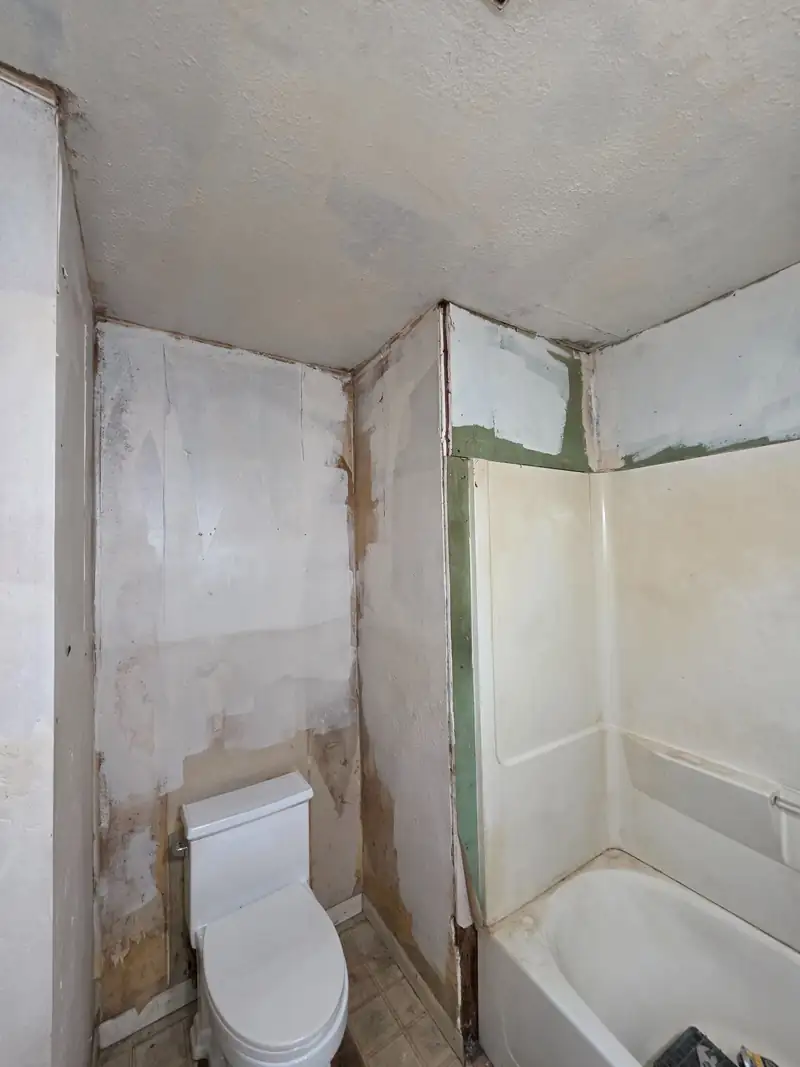
A drywall repair either vanishes or it announces itself every time the light hits the wall. There's very little in between, and the difference has almost nothing to do with skill at spreading mud. It comes down to four things: cutting back to solid material, feathering wide, matching texture, and priming before paint.
Cutting back matters first. A patch fastened to nothing but the surrounding board will crack, because there's no structure behind it. We cut the opening back to the centers of the nearest studs or add backing behind the hole so the new piece is fastened to something solid. On ceilings especially, this is the step that decides whether the repair is still invisible in two years.
Feathering is where most repairs go wrong. The instinct is to fill the hole and stop, which leaves a raised island with a hard edge. Compound has to go on in several thin coats, each one spread wider than the last, so the transition from patch to wall happens across a foot or more. A repair feathered eight inches wide will show under raking light no matter how carefully it was sanded. One feathered wide enough simply won't.
Then texture. Most walls and ceilings aren't perfectly smooth — they have orange peel, knockdown, or a hand-applied texture from whenever the house was built. A glass-smooth patch in the middle of a textured wall catches light completely differently from everything around it, and your eye goes straight to it. Matching the surrounding texture before paint is what makes the repair read as wall rather than as repair.
Priming is the last step and the one that gets skipped most. Joint compound is far more porous than painted drywall. Paint applied directly over an unprimed patch soaks in and dries to a different sheen than the wall around it, so you end up with a dull spot the exact shape and size of your repair — a phenomenon painters call flashing. A coat of primer over the patch evens out the absorption so the finish coat looks uniform.
This is also why we handle drywall, texture, and paint ourselves rather than handing a patched wall off. The repair, the texture match, and the paint are one job, and splitting them is how you end up with a wall that's structurally fine and visibly patched.
If you've got cracks, holes, or water damage to deal with, call (502) 436-3628 and we'll take a look.